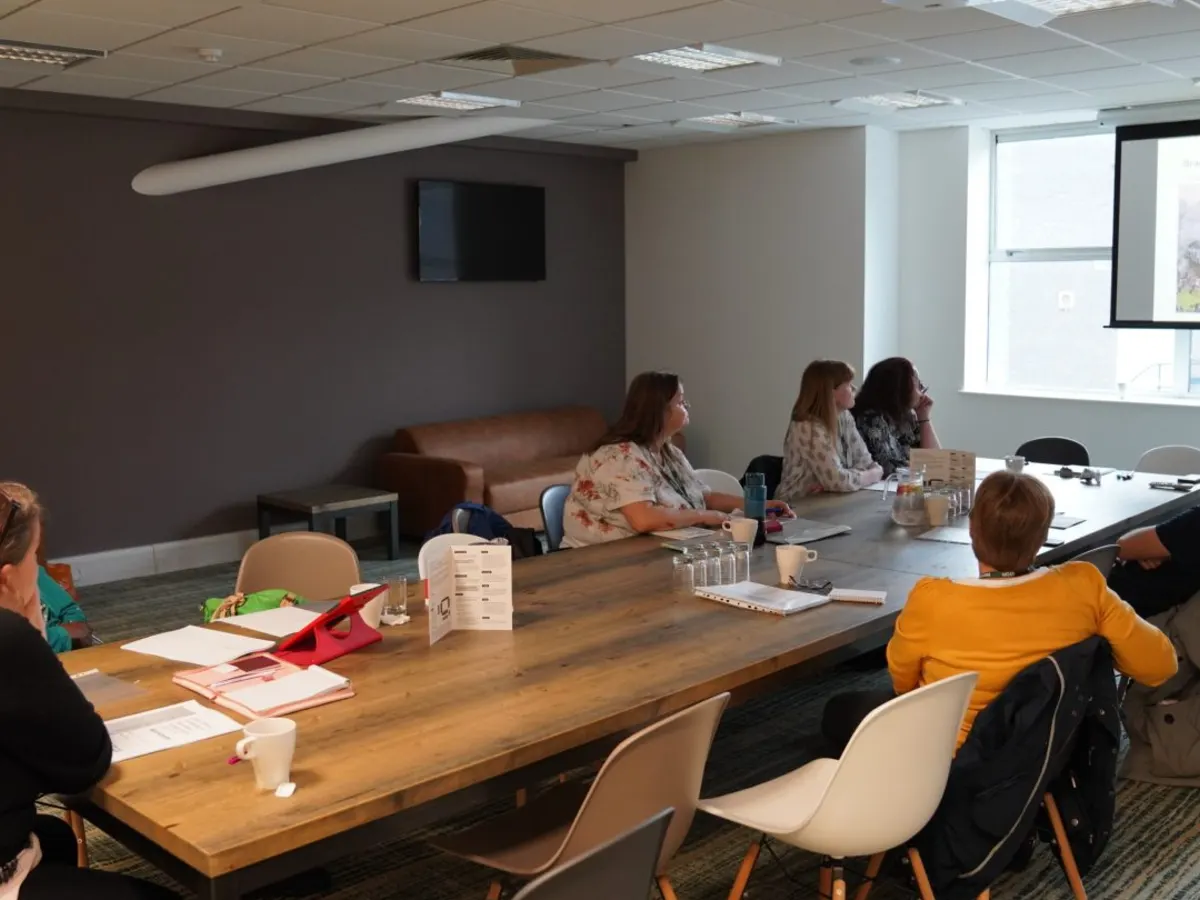
Delegates can run structured debriefs after a critical incident that keep affected staff safe, reduce the risk of lasting trauma and return teams to normal working quickly.
Available on request: this course is delivered for existing clients and by arrangement. Ask us for dates.
Duration(not stated on the page)
DeliveryOn site at client premises or at our Northampton training centre; delivered to large groups, small groups or one to one depending on the situation
Validity(no expiry stated)
PrerequisitesNone stated
Group sizeLarge groups, small groups or one to one depending on the situation
Assessment(no formal assessment stated)
BookingQuote within one working day; PO invoicing
Who it is for
Organisations whose people are exposed to traumatic or violent incidents at work, including CCTV operatives, community wardens and staff at music venues, nightclubs and football clubs. It suits managers and welfare leads who need a structured way to support colleagues after an incident, as well as security providers who want to look after their own teams. Our trainers have a policing and military background in dealing with trauma.
Ex-police trainers
The people teaching powers, evidence and conflict have used them.
Endorsed and accredited
Police Crime Prevention Academy endorsement and the NCFE Award: the combination forces and clients ask for.
Tailored to your powers
Three, four or five days shaped to what the chief officer has actually granted your team.
Refreshers that fit shifts
Half-day live sessions, morning, afternoon or evening.
What the course covers
What Critical Incident Debrief Management (CIDM) is and when to use it
Assessing the impact of a critical incident on staff, responders and survivors
Identifying immediate safety and security issues arising from the incident
Defusing: giving people space to voice thoughts, emotions and experiences without judgement
Validating normal reactions and predicting what people may experience in the aftermath
Conducting a systematic review of the incident and its emotional, cognitive and physical impacts
Bringing closure, anchoring people to their team and community and identifying positives
Supporting re-entry to the workplace and reducing the likelihood of post traumatic stress
Running debriefs one to one, in small groups or in large groups
Want the detailed outline for your team?
We tailor every programme in a planning call. Ask for the full outline and a quote in one go.
CIDM is an adaptive, short term psychological helping process that focuses on an immediate and identifiable problem. It can span pre-incident preparedness, acute crisis management and post-crisis follow up. Its purpose is to help businesses and their people return to daily routine quickly and with less likelihood of experiencing post traumatic stress disorder.
Critical incidents raise stress levels dramatically in a short period of time, and after an incident a new normal is established. The aim of the intervention is to set that new normal as low as possible. The emphasis throughout is on keeping people safe and returning them to more normal levels of functioning. Debriefing is not a critique but a systematic review of the events leading up to, during and after the crisis.
The seven protocols we follow
Safe and Trained debriefs follow seven key protocols: assess the impact on support personnel and survivors; identify immediate safety and security issues; use defusing to allow ventilation of thoughts, emotions and experiences and validate likely reactions; predict events and reactions still to come; conduct a systematic review of the incident and its emotional, cognitive and physical impacts; bring closure and anchor people to their community so the rebuilding process can start; and support re-entry to the workplace or community.
Who we have supported
We have delivered a large number of CIDM programmes for clients in the public and private security industries, ranging from CCTV operatives and community wardens to entertainment venues, nightclubs and football clubs.
Your trainers
N
NickCSAS, RSAS and Chapter 8 trainer
Thirty-four years with Thames Valley Police and the Metropolitan Police, including twelve in police learning and development as an assessing officer and a spell as a sergeant. Also delivers speed awareness courses.
The name that comes up in review after review.
J
JackieCSAS and RSAS trainer
A retired police detective who now delivers our Transport for London CSAS and RSAS programmes.
Her September 2026 TfL cohort passed the exam to a person.
The course was well organised and provided useful knowledge and practical skills. The assessors Jackie and Mark were very helpful, professional and supportive throughout the training.
Munir A.CSAS / RSAS · Sep 2026
★★★★★Trustpilot
Nick presented the course in a very professional manner using his knowledge and experience to make the information easy to digest and relevant to my role in TFL using real life scenario and practical applications.
DaveCSAS / RSAS · Aug 2026
★★★★★Trustpilot
RSAS/CSAS training was very informative and good. It was well paced and our Trainer Nick was very knowledgeable. He made it interesting with his experiences in the past that kept us going.
Mcwayne A.CSAS / RSAS · Jul 2026
★★★★★Trustpilot
The CSAS/RSAS course is an intensive program which is quite insightful and educative. It was delivered by a superb tutor Nick who made the program quite interactive and easy to assimilate.
Send the delegate numbers, location and deadline. We reply with a proposal and a single price within one working day.
We deliver on your site anywhere in the UK, at our Northampton training room, or online where the course allows.
Certificates and cards are issued after the course and logged so you can evidence competence to a client or auditor.
"But we..."
Our staff are not vetted yet
Training can take place before vetting completes; employer approval and individual vetting run alongside it.
We only need the traffic powers
A three-day traffic-management programme covers those without the full five days.
We run shifts and nights
Refreshers run as half-day live sessions in morning, afternoon and evening slots.
We have not applied for employer approval
We send the employer guide and the application route with every quote.
Questions
What counts as a critical incident?
Any event that overwhelms a person's normal coping mechanisms, such as a serious assault, a death or serious injury at a venue, a terrorist incident or threat, a major crowd incident, or witnessing a traumatic event on CCTV. It is the impact on people, not the scale of the event, that matters.
Is this counselling?
No. CIDM is a structured, short term process delivered soon after an incident to stabilise people and help them return to normal functioning. It is not a substitute for clinical treatment, and part of the process is recognising when someone needs onward referral to occupational health or a mental health professional.
Can you deliver the debriefing itself, or do you train our managers to do it?
the page describes both delivering debrief programmes and equipping organisations to support their people. Talk to us about whether you need a facilitated debrief after a specific incident, training for your own managers, or both.
How soon after an incident should a debrief take place?
an initial defusing session is usually held within the first day or so, with a fuller structured debrief typically within a few days once people are out of the acute phase. Timing is agreed case by case.